Identity Security in California’s Private Healthcare Sector: Top Risks and How to Solve Them
July 23, 2025 · 3 min read
In California’s private medical and health industry, safeguarding patient data is not just a compliance requirement — it’s critical to operational continuity and patient safety. As healthcare providers become more digitally connected, identity-based cyber threats are escalating. From credential theft to insider risks and legacy system vulnerabilities, the sector faces growing pressure to secure access to electronic health records (EHRs) and critical infrastructure.
This article explores the top identity security challenges faced by California’s private healthcare providers — and how modern Active Directory (AD) and Entra ID security platforms can help close the gaps.
1. Credential Compromise and Phishing
The Problem
Healthcare organizations are prime targets for phishing, with 23% of all incidents starting this way. Advanced adversary-in-the-middle (AiTM) attacks now bypass multi-factor authentication (MFA) in 75% of business email compromise (BEC) cases, allowing attackers to hijack credentials and gain access to sensitive systems like EHRs and Microsoft 365.
The Impact
A single credential breach in healthcare costs an average of $9.77 million per incident. Clinician confidence is waning, with 96% anticipating increased cybersecurity risks without better controls.
2. Insider Threats
The Problem
Insider threats represent a significant concern:
- 46% are unintentional, often caused by staff under pressure or lacking training
- 25% are malicious, driven by financial gain (PHI is worth up to $20,000 per record on the dark web)
The Impact
Unauthorized access not only jeopardizes patient privacy but can disrupt clinical operations. In fact, 79% of clinicians cite serious legal and financial risks from insider threats.
3. Legacy Systems and Privileged Access Risks
The Problem
Outdated systems and over-privileged accounts are another key vulnerability. Many providers still operate on legacy EHR platforms that don’t support modern security features. In 2023 alone, 43 out of 993 vulnerabilities were remote-control or privilege escalation exploits. Over 61% of organizations cite privileged accounts as their biggest internal risk.
The Impact
These vulnerabilities are a gateway for ransomware attacks (which account for 34% of healthcare incidents) and can result in system downtime, severely impacting patient care and safety.
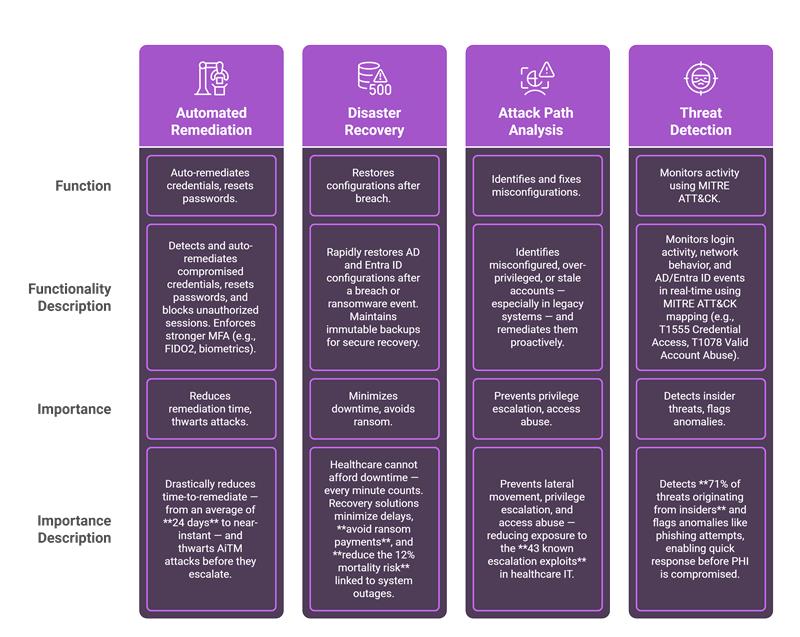
1. Automated Remediation
- What It Does: Detects and auto-remediates compromised credentials, resets passwords, and blocks unauthorized sessions. Enforces stronger MFA (e.g., FIDO2, biometrics).
- Why It Matters: Drastically reduces time-to-remediate — from an average of 24 days to near-instant — and thwarts AiTM attacks before they escalate.
2. Disaster Recovery for Identity Systems
- What It Does: Rapidly restores AD and Entra ID configurations after a breach or ransomware event. Maintains immutable backups for secure recovery.
- Why It Matters: Healthcare cannot afford downtime — every minute counts. Recovery solutions minimize delays, avoid ransom payments, and reduce the 12% mortality risk linked to system outages.
3. Attack Path Analysis
- What It Does: Identifies misconfigured, over-privileged, or stale accounts — especially in legacy systems — and remediates them proactively.
- Why It Matters: Prevents lateral movement, privilege escalation, and access abuse — reducing exposure to the 43 known escalation exploits in healthcare IT.
4. Continuous Threat Detection Mapped to MITRE ATT&CK
- What It Does: Monitors login activity, network behavior, and AD/Entra ID events in real-time using MITRE ATT&CK mapping (e.g., T1555 Credential Access, T1078 Valid Account Abuse).
- Why It Matters: Detects 71% of threats originating from insiders and flags anomalies like phishing attempts, enabling quick response before PHI is compromised.
Final Thoughts
Identity threats in healthcare are growing more targeted, persistent, and costly. In California’s high-risk, high-compliance environment, organizations must go beyond basic MFA and user awareness training.
An advanced Active Directory and Entra ID security platform provides a holistic defense — from automated threat response to disaster recovery — giving clinicians and executives peace of mind while improving resilience against evolving cyber threats.
Looking to reduce identity risk across your healthcare environment?
Let’s talk about how our platform helps protect patient data, reduce downtime, and meet HIPAA and CCPA obligations — without disrupting care.